

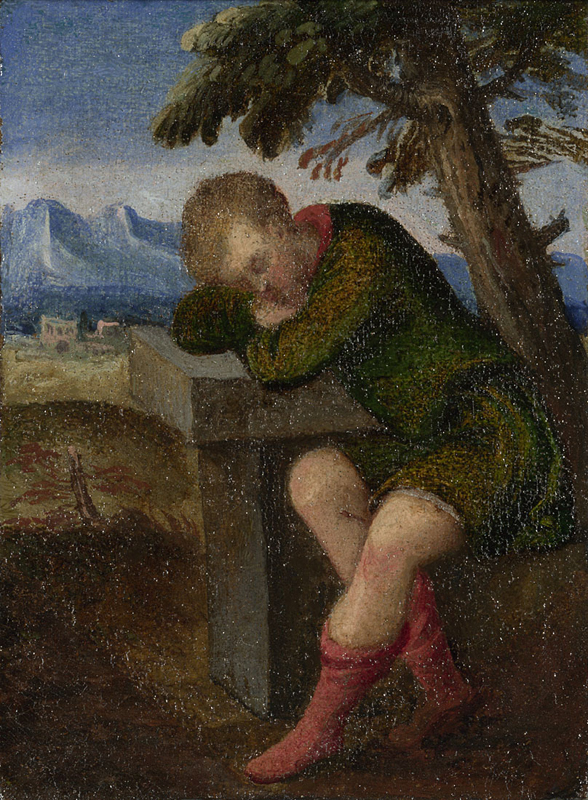
Labor of the Month for August: Rest
By Dr. Edward Mulholland
On the sculpted doorway of many Romanesque churches and Gothic cathedrals, among stories of
Sacred Scripture and the lives of the saints, you will find vignettes of local life in a twelve month
cycle. You can find such a cycle on the main doors of the Cathedral of Lucca, Italy, right under
scenes from the life of its patron, St. Martin. Such “labors of the months,” either painted, tiled in
mosaic, or carved in stone, tied the work of the people to the worship done in the churches. Our
new St. Martin’s Academy newsletter, Ora et Labora, will begin each month highlighting one
such labor of the month from the life of the boys.
It may seem strange to begin a series of labors with rest. But in a sense, it is where all work
begins. And in an even deeper sense, it is where all labor tends. It is the Creator’s seventh day
rest, the eternal jubilee, which we all wish to share in Heaven. It is the ultimate goal of both our
ora and our labora.
But labor and rest don’t necessarily exclude each other. A rest is necessary in order to work more
efficiently, and we can often rest from one type of work by engaging in another.
August has been a time of summer vacation, a rest for the students of St. Martin’s, like the boy in
the image grabbing some shut-eye after picking fruit in summer heat. But it has not been a time
of idleness. While taking time away and resting from schoolwork, there has been time for a
summer job or other pursuits..The Latin root for “vacation,” the verb vacāre, has a double sense
of being free from, and being free for. St. Martin’s boys, once schoolwork and chores are done,
are free for badge work and other projects, and night brings time for needed sleep and rest for
mind and body.
These times of rest are indeed a gift of God, but as we have not here a lasting dwelling, neither
do we have a fully satisfying rest. As St. Augustine wrote, our restless hearts will only truly rest in God.
The English poet George Herbert (1593-1633) wrote that God, among his many gifts, did not
give us true rest so that we might always, as St. Augustine first remarked, be restless for him. It
is his way of drawing us toward Him. Herbert explains this in a poem aptly titled “The Pulley.”
May you soon find time free and restful enough to commit it to memory!
The Pulley
When God at first made man,
Having a glass of blessings standing by,
“Let us,” said he, “pour on him all we can.
Let the world’s riches, which dispersèd lie,
Contract into a span.”
So strength first made a way;
Then beauty flowed, then wisdom, honour, pleasure.
When almost all was out, God made a stay,
Perceiving that, alone of all his treasure,
Rest in the bottom lay.
“For if I should,” said he,
“Bestow this jewel also on my creature,
He would adore my gifts instead of me,
And rest in Nature, not the God of Nature;
So both should losers be.
“Yet let him keep the rest,
But keep them with repining restlessness;
Let him be rich and weary, that at least,
If goodness lead him not, yet weariness
May toss him to my breast.”