

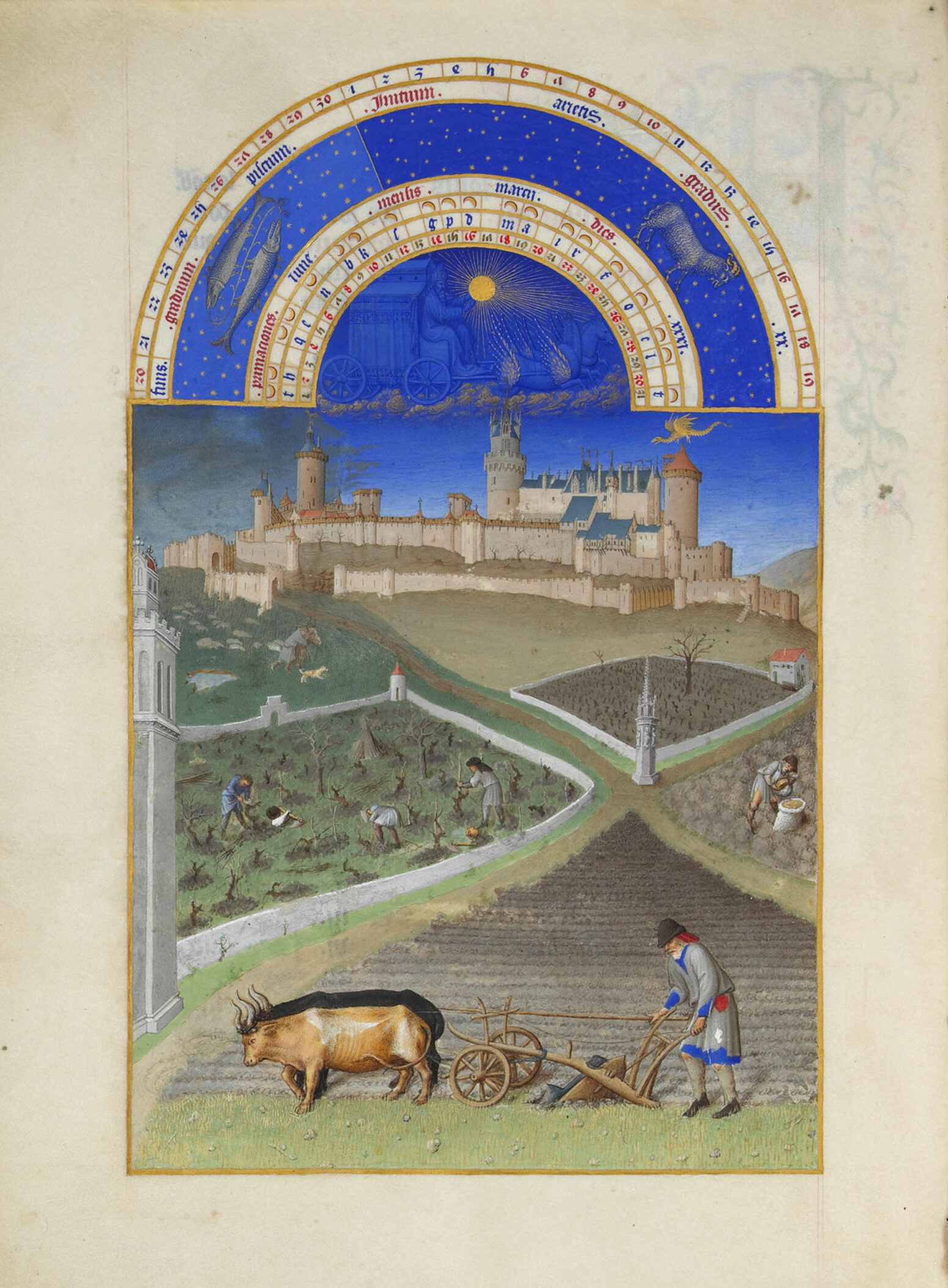
Labor of the Month for September: Plowing
By Dr. Edward Mulholland
As the school year begins and the students’ opening trips have yielded to the first weeks of classes, once
again the furrows need to be dug after summer rest, and eager minds prepared to receive seeds of
wisdom. September’s “Labor of the Month” is plowing.
As my freshman ancient history class has already learned, one of the catalysts for civilization in
Mesopotamia was the invention of the plow. Once we could produce food for more than our own
family, thanks to the saving of manual labor the plow enabled, the food surplus paved the way for
more differentiated labor and the birth of cities. It was, quite literally and moreso, ground-breaking.
Whether pushed manually or by a team of animals, the plow opens the earth and churns dead matter
into the soil, once again enriching and renewing it.
The beginning of the school year is a time for renewal, allowing any laziness or bad habits from the
summer to die away so that we can best receive new seeds of knowledge and virtue. Only then can we
engage in the patient, watchful work of weeding and watering, removing what hampers growth and
fostering what enhances it.
Each year we can begin again because, as sings a verse of Hopkins, “There lives the dearest freshness
deep down things.” It requires persevering, calibrated effort to tap into those fresh depths, as the
weeks, —and we,—plow forward.
Christ reminds us that putting one’s hand to the plow is a commitment. To waver and to look
backward saps our strength and ruins straight, well-ordered rows. “No man putting his hand to the
plough, and looking back, is fit for the kingdom of God.” (Lk 9:62 Douay-Rheims)
And herein lies another great lesson for educators. The one who plows must be attentive to the soil
right in front of him, certainly, but his attention must also focus frequently ahead, on the goal, on the
end of the furrow.
Our President Dan Kerr frequently speaks of the work of education in agricultural terms. He founded
a school on a farm, after all. Over the summer, he gave a presentation at the Chesterton Conference
which explored the lessons educators can learn from the age-old wisdom of tending to the soil. I
cannot recommend it strongly enough.